Research-informed, not overclaimed
Familiar wellbeing ideas, adapted for short mobile moments.
Trana adapts established approaches into brief, practical interactions — without claiming to be a clinical intervention. These references explain the ideas behind Trana's tools, not an endorsement of Trana itself.
Grounding and orienting
Short sensory awareness exercises — notice five things you can see, four you can feel — help bring your nervous system back to the present moment. Trana's Orienting tool adapts this into a one-minute guided practice.
Grounding techniques are widely used in trauma-informed care and anxiety management as practical, low-barrier ways to interrupt distress spirals.
Paced breathing
Slow, deliberate breathing — inhale for 4 seconds, hold for 1, exhale for 6 — activates the parasympathetic nervous system and reduces physiological stress markers. Trana's Breathing Reset uses this rhythm.
Controlled breathing is recommended by the NHS and used in evidence-based anxiety management programmes.
Thought records and reframing
Writing a thought down, examining whether it is a fact or a feeling, and finding a more balanced response is a core technique in cognitive behavioural approaches. Trana's Thought Labelling and Control Circle tools adapt this.
Thought records are recommended in NICE guidance for mild to moderate anxiety and depression as part of guided self-help.
Behavioural activation and tiny steps
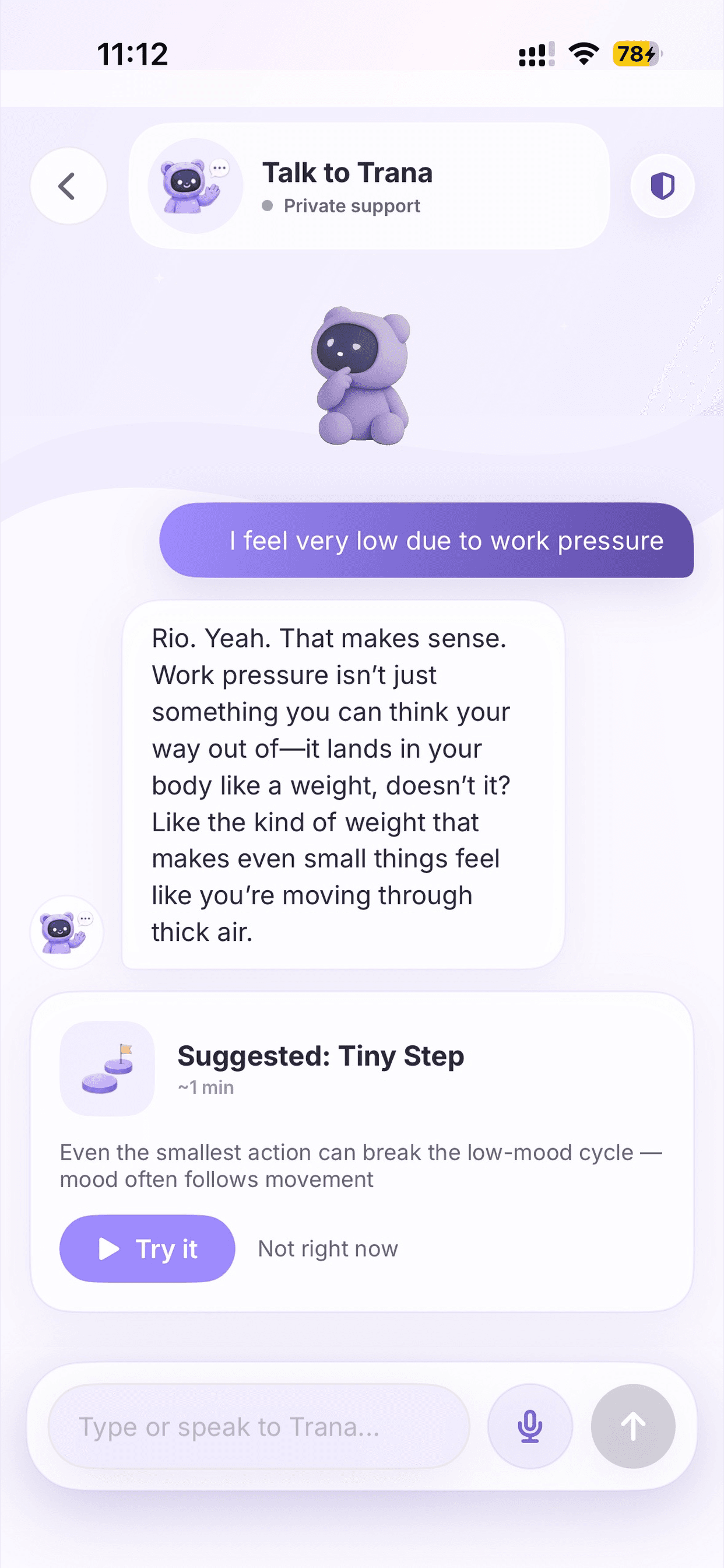
When low mood makes everything feel impossible, starting with the smallest possible action — not a goal, just an action — can interrupt the low-mood, low-activity cycle. Trana's Tiny Step Activation tool is built on this principle.
Behavioural activation is a NICE-recommended component of depression treatment and is effective in self-help formats.
Expressive writing and journaling
Writing about difficult experiences and feelings — without needing to share them — has been shown to support emotional processing and mood regulation. Trana's journal is private and unrestricted.
Research by Pennebaker and others consistently supports the benefit of regular expressive writing for emotional wellbeing.
Safety planning
A personal safety plan — listing warning signs, coping steps, safe places, trusted people, and crisis resources — makes it easier to navigate a crisis before it becomes overwhelming. Trana's safety plan feature is always free.
Safety planning is a recognised component of suicide prevention, supported by the VA, MIRECC, and international crisis organisations.
Disclaimer: These references are included for context only. Trana is not a medical device, clinical intervention, or substitute for professional mental health care. The tools and content in Trana adapt wellbeing principles for practical daily use — they are not treatments.